- Call Us: +91-9988543543

21st June 2026 | By Admin
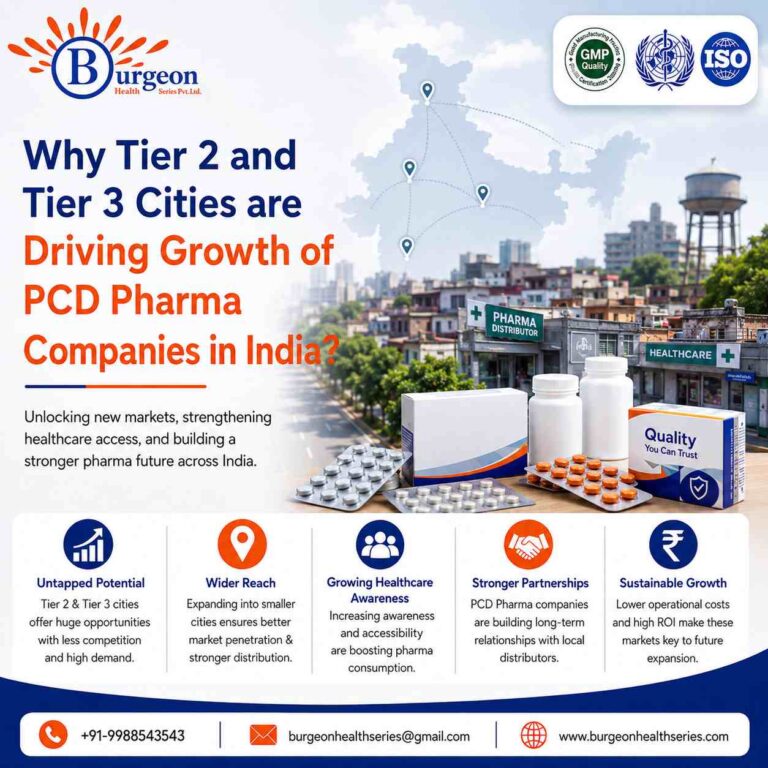
PCD Pharma Companies in India are witnessing their fastest growth not in metro cities anymore, but in the smaller towns spread across the country. Over the past decade, Tier 2 and Tier 3 cities have transformed from being overlooked markets into the biggest growth engines for the pharmaceutical distribution business. Rising disposable incomes, improved healthcare infrastructure, and a growing awareness about quality medicines have created massive demand in these regions.
For entrepreneurs and medical professionals looking to enter the pharma business, this shift has opened up a golden opportunity to start a Pharma Franchise in areas that were once considered too small for serious investment. This blog explores exactly why this shift is happening and how it is reshaping the franchise business model.
The growth story of PCD Pharma Companies in India is closely linked to changing demographics and healthcare needs outside metro cities. Government initiatives such as Ayushman Bharat and the expansion of Jan Aushadhi stores have increased medicine accessibility in smaller towns, creating a ready market for a Pharma Franchise Company willing to set up local distribution. At the same time, lower real estate and operational costs in Tier 2 and Tier 3 cities mean a Pharma Company Franchise can achieve profitability faster than in saturated metro markets. Many entrepreneurs are also discovering that starting a PCD Pharma Company in these regions requires comparatively lower capital investment, making it an attractive option for first-time business owners and medical representatives looking to become independent distributors.
Improved literacy, growing internet penetration, and better connectivity have made people in Tier 2 and Tier 3 cities far more health-conscious than before. This has directly increased footfall at local clinics, nursing homes, and pharmacies, pushing demand for a reliable PCD Pharma Franchise that can supply quality medicines consistently. Patients today actively look for medicines manufactured by the Best Pharma Company in India, even in smaller towns, because trust in branded and WHO-GMP certified products has grown significantly. This changing mindset has encouraged many regional distributors to associate with a PCD Pharmaceutical Company rather than relying on unorganized local suppliers, further formalizing the medicine supply chain in these areas.
The franchise model is uniquely suited to smaller cities because it allows a Pharma Franchise Company to expand its reach without the heavy overhead of setting up company-owned outlets everywhere. A PCD Pharma Franchise Company grants monopoly rights to a local distributor for a defined territory, allowing that person to build a business using an established brand name and product range. This model gives local entrepreneurs access to a wide range of Products PCD Pharma Franchise catalogues, covering tablets, capsules, syrups, injectables, and derma ranges, without the need to invest in manufacturing infrastructure themselves. It is a low-risk, high-reward structure that has made pharma entrepreneurship achievable for people who previously had no way to enter this industry. Since the parent company handles manufacturing, quality control, and regulatory compliance, the local partner can focus entirely on building relationships with doctors, chemists, and hospitals within their territory, which further speeds up business growth in these developing markets.
Selecting the right partner is the most important decision when entering this business. A good Pharma Company for Franchise should hold valid WHO-GMP and ISO certifications, offer transparent monopoly based agreements, and provide strong marketing support such as visual aids, product samples, and promotional inputs. Before finalizing any deal, it is wise to compare a Franchise Medicine Company List and shortlist companies with a proven track record, wide product portfolio, and consistent supply chain. A reliable PCD Pharma Company will also offer clear documentation, timely dispatch, and dedicated support staff to help new franchise partners navigate regulatory requirements specific to their state. Taking the time to visit the manufacturing unit or request client references can also help new entrepreneurs avoid common pitfalls and build a long-term, mutually beneficial partnership.
Cost transparency plays a huge role in why Tier 2 and Tier 3 cities are attracting so much franchise interest. Most companies publish a detailed PCD Pharma Companies Price List so that prospective partners can evaluate margins before committing capital. Compared to metro cities, a Pharma Company Franchise in a smaller town typically requires a lower initial investment for stock, marketing material, and registration, while still offering healthy margins because of reduced competition. This favorable cost-to-return ratio is a key reason why so many medical representatives and small business owners are choosing to build their future in these emerging markets rather than crowded urban centers. Reviewing the price list carefully also helps new partners plan their working capital and set realistic sales targets from the very first month of operation.
Q1: Is it profitable to start a PCD Pharma Franchise in a Tier 2 or Tier 3 city?
Yes, it is often more profitable due to lower competition, reduced operational costs, and rising healthcare demand. Many franchise partners in smaller cities report faster break-even periods compared to metro locations, making it a financially sound choice.
Q2: How do I choose a reliable Pharma Franchise Company?
Check for WHO-GMP and ISO certification, monopoly rights, transparent pricing, and a wide product range. Reading client reviews and requesting a sample price list also helps verify the company’s credibility before signing any agreement.
Q3: What is the typical investment required for a PCD Pharma Company franchise?
Investment varies by company and product range but generally starts modestly, covering initial stock, security deposit, and marketing material. Smaller cities usually require lower upfront capital compared to metro areas.
Conclusion
Tier 2 and Tier 3 cities are no longer secondary markets for the pharmaceutical industry; they have become the primary growth drivers for PCD Pharma Companies in India. Improved infrastructure, rising health awareness, government support, and lower operational costs have combined to make these regions the most promising territories for franchise expansion. For anyone considering entry into this sector, partnering with an established, certified company and doing thorough research on product range and pricing will set the foundation for long-term success in this rapidly growing industry.